A taste of the coast · Breakfast
Laverbread cakes
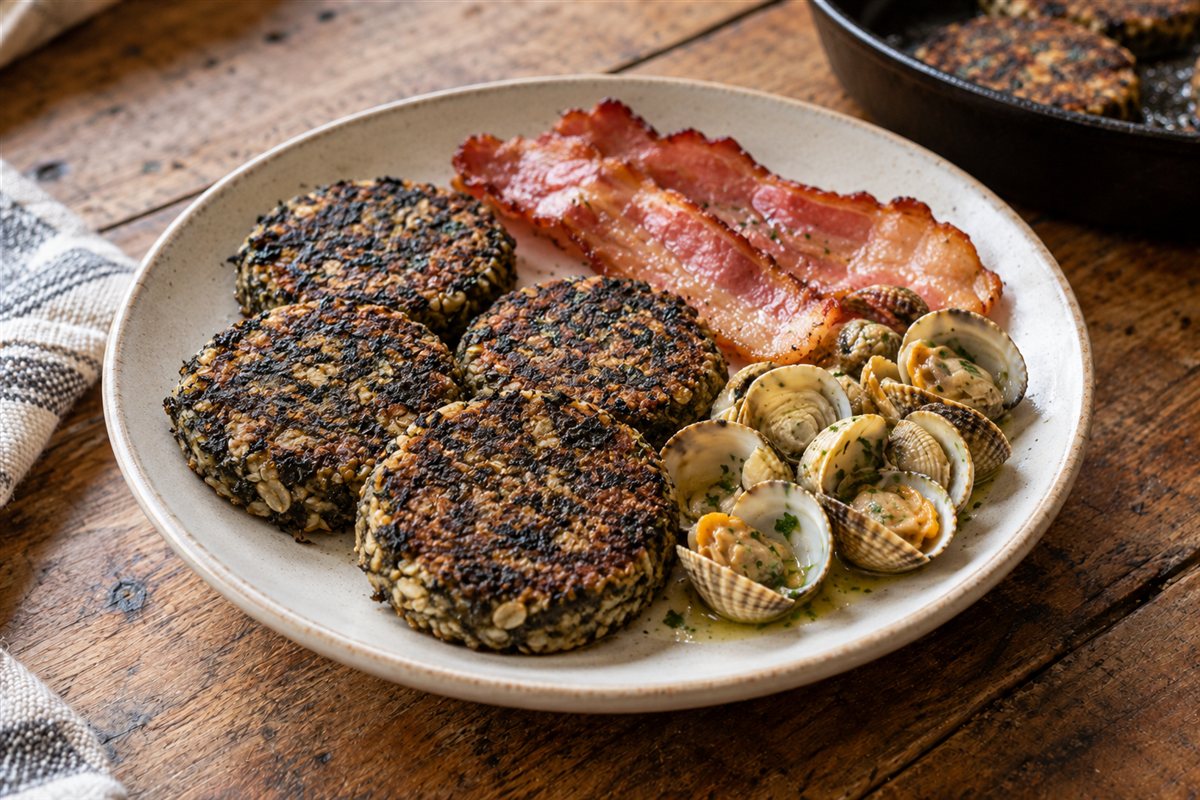
Dark, savoury and crisp at the edges, laverbread cakes are what happens when a spoonful of cooked seaweed meets a handful of oats and a hot pan. Fry them in the bacon fat and serve them alongside the bacon, with a few cockles if you can find them.
What laverbread actually is
Laverbread, or bara lawr, is not bread at all. It is laver, a fine, dark seaweed gathered from the rocks along the Welsh coast, washed many times and then cooked slowly for hours until it collapses into a soft, glossy, almost black purée. The flavour is deep and savoury, a little like the sea and a little like olives or spinach, with a gentle briny edge.
Most cooks today buy it ready-cooked, either fresh from a fishmonger or market stall, or in tins. Both work well here. Fresh laverbread should be kept in the fridge and used within a few days; any you will not use soon can be frozen in small portions.
On its own, laverbread is too soft to fry. Mixing it with oatmeal gives it body, so it can be shaped into small cakes that hold together in the pan and turn crisp on the outside while staying soft in the middle.
What you’ll need
Tick things off as you go.
Take your time
- Mix and rest. Tip the laverbread into a bowl and stir in the 60 g oatmeal, the pepper and the lemon juice, if using. The mixture should be soft but shapeable, a bit like a thick porridge. Leave it for 10 minutes so the oats can absorb some of the moisture.
- Shape the cakes. Spread the extra oatmeal on a plate. With damp hands, take a heaped tablespoon of the mixture, roll it into a ball and flatten it into a cake about 6 cm across and 1.5 cm thick. Press both sides into the oatmeal. Repeat to make 8 cakes. If the mixture is too wet to hold its shape, work in another tablespoon of oatmeal.
- Fry slowly. If you are cooking bacon, fry it first and keep it warm, leaving the fat in the pan. Otherwise heat the fat or oil in a heavy frying pan over a medium heat. Add the cakes in a single layer and cook for 3 to 4 minutes, without moving them, until a crisp crust has formed underneath.
- Turn and finish. Carefully turn each cake with a thin spatula and cook for another 3 to 4 minutes, until crisp on both sides and piping hot in the middle. Drain briefly on kitchen paper.
- Serve straight away. Warm the cockles for a minute or two in the same pan, if using. Serve the laverbread cakes hot with the bacon, the cockles and a wedge of lemon.
A traditional Welsh breakfast
In south-west Wales, particularly around the Gower and the coast near Swansea and Carmarthen, laverbread has long been part of a cooked breakfast. The classic plate is simple: laverbread, either warmed through in the pan or fried as little oat cakes, with bacon and a spoonful of cockles from the nearby estuary. Some cooks add a fried egg; others serve it on toast. The salty bacon and the sweet, briny cockles suit the mellow seaweed well.
Getting the texture right
Laverbread varies from batch to batch. Some is quite loose, some thicker, so the amount of oatmeal needed can change. Add it gradually: the cakes should hold their shape when pressed, but stay soft enough that they do not crack around the edges. Fine or medium oatmeal gives the smoothest result. Jumbo oats are too coarse to bind properly, so blitz them first if that is all you have.
Keep the heat moderate. Laverbread cakes catch easily because of their dark colour, and it can be hard to see when they are burning. A steady medium heat gives a crust without scorching. Turn them only once, and use a thin spatula so they do not break.
Making them ahead
The mixture can be made the evening before and kept covered in the fridge; it firms up overnight, which makes shaping easier. Shaped, uncooked cakes can also be frozen on a tray, then packed into a bag. Fry them from frozen over a slightly lower heat, allowing a few extra minutes each side, until hot all the way through.
Cooked cakes are best eaten fresh, but leftovers reheat well in a dry frying pan over a low heat.
Other ways to serve laverbread
Laverbread is good stirred into scrambled eggs, spread on hot buttered toast with a squeeze of lemon, or warmed with a little butter and served beside lamb. It also makes a savoury sauce for fish when loosened with a splash of cream or stock. For a quick Welsh brunch, serve the cakes with a Welsh rarebit or a stack of crempog, and keep the kettle on.